
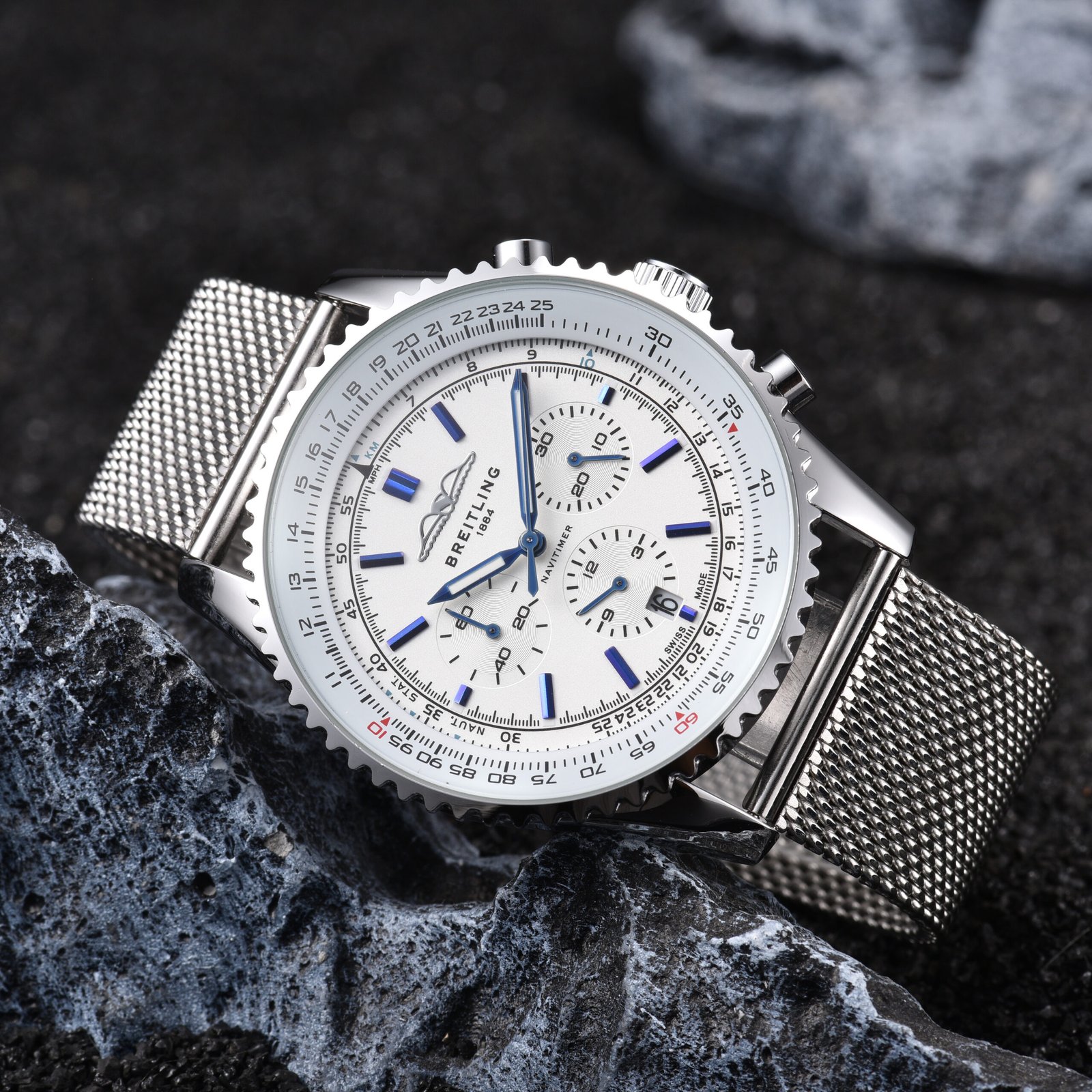
Chronograph Watch Guide: What It Is and How to Use It (2026)
Few watches look as purposeful as a chronograph watch. The extra pushers, the sub-dials and the scales around the bezel give it a technical, sporty character that has made it one of the most popular watch styles in the world. Yet many owners never learn to use the stopwatch function properly. This guide explains exactly what a chronograph watch is, how each part works and how to use it step by step.
Quick answer: A chronograph watch is a watch with a built-in stopwatch. The top pusher (usually at 2 o’clock) starts and stops the timer, and the bottom pusher (at 4 o’clock) resets it to zero. A large central seconds hand counts seconds, while small sub-dials record elapsed minutes and hours. Many chronographs also have a tachymeter scale that calculates speed over a known distance.

Key Takeaways
- A chronograph watch is a watch with a built-in stopwatch.
- The top pusher starts and stops; the bottom pusher resets.
- Sub-dials record elapsed minutes and hours.
- A tachymeter calculates speed over a known distance in under 60 seconds.
- Never reset or press pushers underwater unless the watch is designed for it.
What Is a Chronograph Watch?
The word “chronograph” comes from the Greek words chronos (time) and graph (writing), meaning “time writer.” Early chronographs, invented in the early nineteenth century, literally marked a dial with ink to record elapsed time. Today, a chronograph watch shows normal time like any other watch and adds an independent stopwatch you can start, stop and reset whenever you like.
Chronographs became essential tools for pilots, racing drivers, doctors, scientists and military personnel. In the 1960s, a manually wound chronograph was famously qualified for spaceflight and later worn on the Moon, which helped turn the chronograph watch into a cultural icon. Read more on the history of the chronograph.
Chronograph vs Chronometer: Not the Same Thing
People often confuse these two words, but they mean very different things:
| Term | Meaning |
|---|---|
| Chronograph | A watch with a stopwatch function (pushers and sub-dials). |
| Chronometer | A watch certified for high accuracy, such as by the Swiss COSC institute. |
A watch can be a chronograph, a chronometer, both or neither. A “chronometer chronograph” is both highly accurate and equipped with a stopwatch.
Anatomy of a Chronograph Watch
Before you start timing, it helps to know each part of the dial and case.
The pushers
- Start/stop pusher: usually at 2 o’clock. Press once to start, again to stop, and again to restart from where it stopped.
- Reset pusher: usually at 4 o’clock. Press it only when the chronograph is stopped to return all hands to zero.
- Crown: at 3 o’clock, used to set the time and, on mechanical watches, to wind the movement.
The central chronograph seconds hand
This large hand stays at 12 o’clock until you start the chronograph. It then sweeps around the dial, counting seconds of elapsed time. On most watches it is a different colour or shape from the normal time hands.
The sub-dials (registers)
Most chronograph watch dials have two or three small sub-dials:
- 30-minute or 60-minute counter: records how many minutes have passed.
- 12-hour counter: records elapsed hours on many models.
- Running seconds: a small seconds hand for normal time, which runs constantly.
Sub-dial layouts vary. A “bi-compax” layout has two sub-dials, while a “tri-compax” has three. Understanding which sub-dial does what is the key to reading your chronograph correctly.
The tachymeter scale
Many chronographs have a tachymeter printed on the bezel or the outer edge of the dial. It lets you calculate speed over a known distance, usually one kilometre or one mile. Learn more about the tachymeter.
How to Use a Chronograph Watch Step by Step
Follow these steps to time anything, from a pasta dish to a race lap.
- Check the hands are at zero. The central chronograph hand should point to 12 and the counters should be at zero. If not, press the reset pusher.
- Start timing. Press the top pusher at 2 o’clock. The central seconds hand begins to sweep.
- Watch the counters. After each full rotation of the central hand, the minute counter advances by one minute.
- Stop timing. Press the top pusher again. All chronograph hands freeze.
- Read the result. Read hours on the hour counter, minutes on the minute counter and seconds from the central hand.
- Continue if needed. Press the top pusher again to resume timing from where you stopped. This is called “add timing.”
- Reset. When finished, press the bottom pusher at 4 o’clock to return everything to zero.
- Never reset while running. On most mechanical chronographs, pressing reset while the chronograph is running can damage the mechanism.
How to Use the Tachymeter
The tachymeter turns your chronograph watch into a speedometer. Here is how:
- Start the chronograph as you pass a starting marker, such as a kilometre post.
- Stop it when you pass the next marker exactly one kilometre or mile later.
- Read the number on the tachymeter scale where the central chronograph hand stopped.
- That number is your average speed in kilometres or miles per hour.
For example, if it takes 30 seconds to travel one kilometre, the hand points to 120 on the scale, which means 120 km/h. The tachymeter works only for events under 60 seconds.
You can also use it to measure production rates. If a machine produces one item in 20 seconds, the tachymeter reading of 180 tells you it produces 180 items per hour.
Types of Chronograph Watch
Chronographs come in several technical variations. Here are the most important ones.
Standard chronograph
The classic type described above, with start/stop and reset functions.
Flyback chronograph
A flyback lets you reset and restart the chronograph instantly with a single press of the reset pusher while it is running. Pilots used it to time consecutive flight legs without three separate presses.
Split-seconds (rattrapante) chronograph
A rattrapante has two central chronograph hands. You can stop one to record an intermediate time, such as a lap, while the other keeps running. Press again and the stopped hand “catches up.” It is one of the most complex chronograph complications.
Mono-pusher chronograph
A mono-pusher uses a single button, often built into the crown, to start, stop and reset in sequence. It creates a very clean, elegant case design.
Quartz chronograph
Quartz chronographs use battery-powered movements. They are often thinner, more affordable and very accurate, and many can time to 1/10th or 1/20th of a second.
Automatic vs manual chronograph
Mechanical chronographs can be self-winding or hand-wound. Our automatic vs quartz watch guide explains the difference in more depth.
Column Wheel vs Cam: What Collectors Talk About
Inside a mechanical chronograph watch, the start, stop and reset functions are controlled by either a column wheel or a cam lever system.
- Column wheel: a small castle-shaped wheel that coordinates the levers. It is traditional, gives a smooth and crisp pusher feel and is often considered more prestigious.
- Cam system: a simpler, robust and cost-effective design used in many popular movements. Pushers feel slightly firmer.
Both work well. The column wheel is valued by enthusiasts for its craftsmanship and feel.
A Brief History of the Chronograph Watch
The chronograph has a fascinating story that spans two centuries of innovation.
The first chronographs (1810s–1820s)
In 1816, French watchmaker Louis Moinet created an instrument for timing astronomical observations that could measure intervals down to a sixtieth of a second. A few years later, in 1821, Nicolas Rieussec developed a device to time horse races in Paris. It dropped ink onto a rotating dial, which is where the “time writer” name comes from.
The wristwatch chronograph (1910s–1930s)
Early chronographs were pocket watches. In the 1910s, watchmakers began producing chronographs for the wrist, and in the 1930s the second pusher was added so the chronograph could be stopped and restarted without resetting. This two-pusher layout is still standard today.
The golden age (1940s–1960s)
Chronographs became essential tools for military pilots, racing teams and doctors. Many classic designs with slide rule bezels, tachymeter scales and panda dials were born in this era. The chronograph watch became a symbol of adventure and precision.
The automatic chronograph race (1969)
In 1969, several watchmakers raced to release the first self-winding chronograph movement. A Swiss consortium, a Swiss manufacture and a Japanese manufacturer all unveiled automatic chronograph calibres within months of each other. Collectors still debate who was truly first, and the movements they created influenced chronographs for decades.
Today
Modern chronographs combine traditional designs with new materials, silicon components and longer power reserves. Quartz chronographs offer precise timing at accessible prices, and vintage-inspired designs remain extremely popular.
Other Scales You May Find on a Chronograph Watch
Not every chronograph has a tachymeter. Depending on its purpose, a chronograph watch may carry one of these scales instead:
| Scale | What it measures | Typical user |
|---|---|---|
| Tachymeter | Speed over a known distance | Drivers and racing fans |
| Telemeter | Distance to an event using the speed of sound | Military and storm watchers |
| Pulsometer | Heart rate in beats per minute | Doctors and athletes |
| Slide rule | Fuel, speed and distance calculations | Pilots |
| Decimal scale | Time in hundredths of a minute | Engineers and industry |
How to use a telemeter
Start the chronograph when you see a flash of lightning and stop it when you hear the thunder. The telemeter scale shows how far away the storm is, because sound travels at a known speed through air.
How to use a pulsometer
Start the chronograph and count heartbeats until you reach the number printed on the scale, often 15 or 30. Stop the chronograph and read the beats per minute directly from the dial.
Popular Chronograph Dial Layouts
The arrangement of the sub-dials gives every chronograph watch its personality:
- Bi-compax (two registers): sub-dials at 3 and 9 o’clock. Clean, symmetrical and classic.
- Tri-compax (three registers): sub-dials at 3, 6 and 9 o’clock. Busy, sporty and highly recognisable.
- Vertical layout: sub-dials at 12 and 6 o’clock. Elegant and less common.
- Panda and reverse panda: high-contrast colour schemes that make sub-dials easier to read at a glance.
If you value legibility, choose a layout with strong contrast and clearly marked counters.
Everyday Uses for a Chronograph Watch
You do not need to be a racing driver to enjoy a chronograph. Practical uses include:
- Timing cooking, such as steaks, eggs or pasta.
- Tracking parking meters or laundry cycles.
- Timing workouts, intervals and rest periods.
- Measuring a presentation or speech.
- Timing laps at the track or on a bike.
- Measuring your heart rate with a pulsometer scale, if your watch has one.
How to Choose the Right Chronograph Watch
When shopping for a chronograph watch, consider these factors:
- Size: chronographs are often thicker; 40–42mm suits most men. See our watch size guide.
- Dial legibility: high contrast between sub-dials and the main dial makes reading easy. “Panda” (white dial, black sub-dials) and “reverse panda” (black dial, white sub-dials) are popular for this reason.
- Bezel: tachymeter for racing, slide rule for pilots, or a plain bezel for dressier looks.
- Movement: automatic for craftsmanship, quartz for slimness and accuracy.
- Water resistance: at least 50–100m for everyday wear. Never press pushers underwater unless the watch is specifically designed for it.
- Strap: steel bracelets are versatile, leather is classic, and rubber is sporty.
Common Chronograph Mistakes to Avoid
Even experienced owners make these mistakes. Avoid them and your chronograph will run smoothly for years:
- Resetting while running: always stop the chronograph before pressing reset, unless it is a flyback.
- Misreading the counters: check which sub-dial counts minutes and which shows running seconds before you rely on a reading.
- Pressing pushers underwater: this is one of the easiest ways to let water into the case.
- Ignoring stiff pushers: if the pushers feel gritty or stick, it is time for a service.
- Leaving it running for days: on many mechanical movements this adds wear and may reduce accuracy.
Is a Chronograph Watch Worth It?
For most people, yes. A chronograph adds genuine everyday usefulness and a distinctive, sporty look without sacrificing elegance. It suits a wide range of wrists and wardrobes, and it is one of the most enjoyable complications to use. The main trade-offs are slightly greater thickness and, for mechanical models, higher service costs than a simple time-only watch.
If you love interaction, mechanics and a dial with plenty of character, a chronograph watch is one of the most rewarding watches you can own.
How to Style a Chronograph Watch
A chronograph watch is versatile. A steel chronograph on a bracelet suits smart-casual outfits, a racing chronograph on rubber suits weekends, and a slim chronograph on leather can even work with a suit. Gold and rose-gold chronographs add a bold, glamorous touch. For more ideas, read our guide on how to wear a watch.
Caring for Your Chronograph
- Do not operate pushers underwater unless your watch is rated for it.
- Reset only when the chronograph is stopped.
- Running the chronograph continuously on a mechanical watch can increase wear and reduce power reserve on some movements, so use it when you need it.
- Service mechanical chronographs every three to five years.
Our full watch care guide covers cleaning, storage and servicing.
Frequently Asked Questions
What is a chronograph watch?
A chronograph watch is a watch with a built-in stopwatch. It has pushers to start, stop and reset the timer, plus sub-dials that record elapsed minutes and hours.
How do I use the chronograph on my watch?
Press the top pusher to start, press it again to stop, and press the bottom pusher to reset to zero. Read seconds from the central hand and minutes and hours from the sub-dials.
What is the difference between a chronograph and a chronometer?
A chronograph is a stopwatch function. A chronometer is a watch officially certified for high accuracy. A watch can be one, both or neither.
Is it bad to leave the chronograph running?
On many mechanical watches it is fine but causes extra wear and can reduce power reserve. It is best to use the chronograph only when you need it.
What does the tachymeter on a watch do?
The tachymeter calculates speed over a known distance. Start the chronograph at the start point, stop it after one kilometre or mile, and read your speed on the scale.
Can I press chronograph pushers underwater?
Only if the watch is specifically designed for it. Pressing pushers underwater on most chronographs can let water into the case.
What is a flyback chronograph?
A flyback chronograph lets you reset and restart the timer instantly with one press of the reset pusher while it is running. It was designed for pilots who needed to time consecutive legs of a flight quickly.
Conclusion
A chronograph watch blends practicality and style like few other watches. Once you understand the pushers, the sub-dials and the tachymeter, you will find yourself using it every day, from timing your coffee to tracking a workout. Choose the size, movement and dial layout that suit your life, and you will have a watch that is as useful as it is handsome, a companion ready to time every important moment of your day.
Discover sporty and elegant chronographs in our men’s watches and luxury watches collections, or explore every style in our guide to the types of watches.