
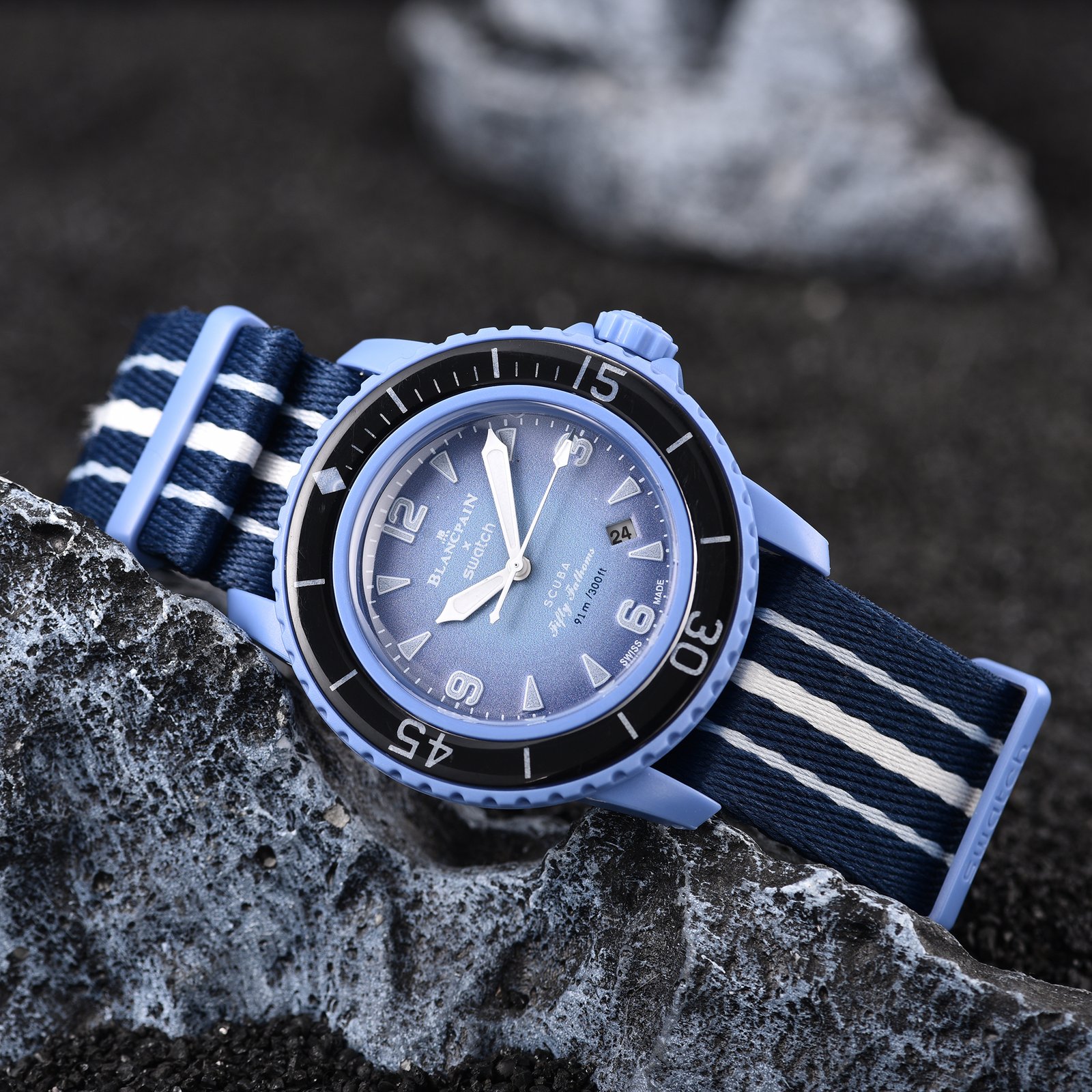
Watch Water Resistance Explained: What 30m, 50m, 100m and 200m Really Mean
“Can I swim with my watch?” It is one of the most common questions watch owners ask, and the answer is not as obvious as the number on the dial suggests. A watch marked 30 metres is not built for diving to 30 metres, and in many cases it should not go swimming at all. Understanding water resistance protects your watch from one of the most expensive types of damage there is.
Quick answer: Water resistance ratings describe the static pressure a watch withstood in a laboratory test, not a safe diving depth. In practice, 30m (3 ATM) means splash resistant only, 50m (5 ATM) handles brief immersion and light swimming, 100m (10 ATM) is suitable for swimming and snorkelling, 200m (20 ATM) handles serious water sports and recreational diving, and ISO 6425 “Diver’s” watches are certified for scuba diving.

Key Takeaways
- Water resistance ratings are laboratory pressure figures, not safe diving depths.
- 30m means splashes only; 100m is the minimum for regular swimming.
- ISO 6425 certifies true divers’ watches with far stricter tests.
- Water resistance fades as gaskets age, so test it every year if you swim.
- Avoid hot showers, saunas and pressing pushers underwater.
Waterproof vs Water Resistant: Why the Words Matter
You will rarely see the word “waterproof” on a quality watch today. That is because no watch is completely and permanently waterproof. Gaskets age, crowns get opened and cases take knocks. For this reason, international standards and many consumer laws require watchmakers to use the term “water resistant” instead.
Water resistance is not a permanent feature. It is a condition that must be maintained through regular checks and servicing, just like the brakes on a car.
What Water Resistance Ratings Actually Mean
Watch water resistance is usually expressed in metres, ATM (atmospheres) or bar. These units are almost interchangeable: 1 ATM is approximately 1 bar, which corresponds to roughly 10 metres of water.
The important point is that these figures come from a static pressure test in a laboratory. The watch is held perfectly still in a pressure chamber. In real life, moving your arm through water, diving into a pool or being hit by a wave creates dynamic pressure that can be much higher. That is why the practical guidance below is far more conservative than the numbers suggest.
| Rating | Pressure | What you can safely do | What to avoid |
|---|---|---|---|
| Water resistant (no number) / 30m | 3 ATM / 3 bar | Rain, splashes, washing hands | Swimming, showering, bathing |
| 50m | 5 ATM / 5 bar | Brief immersion, light surface swimming | Diving, snorkelling, water sports |
| 100m | 10 ATM / 10 bar | Swimming, snorkelling, surfing | Scuba diving, high diving |
| 200m | 20 ATM / 20 bar | Water sports, recreational scuba | Saturation diving |
| 300m+ / ISO 6425 Diver’s | 30+ ATM | Scuba diving | Depths beyond the certified rating |
A Closer Look at Each Rating
30m water resistance (3 ATM)
This is the most misunderstood rating. A 30m watch can handle rain, sweat and the occasional splash while washing your hands. It should not be worn in the pool, the sea or the shower. Most dress watches and many fashion watches fall into this category.
50m water resistance (5 ATM)
A 50m watch is a little more robust. It can survive brief immersion, such as accidentally dipping your hand in water or a gentle swim at the surface. However, it is not designed for regular swimming, diving into a pool or water sports.
100m water resistance (10 ATM)
At 100m, a watch is genuinely suitable for swimming, snorkelling and most water activities at the surface. This is the rating most experts recommend for a versatile everyday watch you might wear on holiday.
200m water resistance (20 ATM)
A 200m watch can handle serious water sports, jet skiing, surfing and recreational scuba diving. Many dive watches carry this rating, usually with a screw-down crown and caseback.
300m and beyond
Watches rated to 300m and higher are built for professional diving. Some include a helium escape valve, which allows helium gas to escape during decompression after saturation diving.
The ISO Standards: ISO 22810 and ISO 6425
Two international standards govern how water resistance is tested and marketed.
ISO 22810 (everyday water-resistant watches)
ISO 22810 covers general water-resistant watches. Watches are tested for resistance to overpressure, immersion at shallow depth, strain on the crown and pushers, and thermal shock. Importantly, testing is often done on samples from a production batch rather than every single watch.
ISO 6425 (divers’ watches)
ISO 6425 is far stricter. To be labelled as a “Diver’s” watch, every individual watch must pass a series of demanding tests. These include:
- Water resistance tested at 125% of the rated depth.
- A minimum rating of 100m.
- A unidirectional rotating bezel or another device to monitor elapsed time.
- Legibility in total darkness at a distance of 25 cm.
- Resistance to magnetism, shocks and salt water.
- Condensation and thermal shock tests.
You can read a clear explanation of what these ratings mean in practice in this Gear Patrol guide to water-resistant watches and the background of the diving watch.
The Parts That Keep Water Out
Water resistance depends on a system of seals and tight tolerances working together:
- Gaskets: rubber or synthetic O-rings that seal the crystal, caseback, crown and pushers.
- Crown: a screw-down crown threads into the case to compress its gasket, providing a much stronger seal than a push-pull crown.
- Caseback: screw-down casebacks are generally more water resistant than snap-on ones.
- Crystal: a thick sapphire crystal pressed or glued into a gasket keeps water out at depth. Learn more in our sapphire crystal vs mineral glass guide.
- Pushers: chronograph pushers are potential weak points unless they screw down.
Why Water Resistance Fades Over Time
This is the most overlooked fact about water resistance: it does not last forever. Gaskets are made of rubber-like materials that dry out, harden and crack with age. Sweat, perfume, sunscreen, chlorine and salt water accelerate this process. Heat makes it worse still.
That is why a watch rated to 100m when new may no longer be safe to swim with after five years if it has never been checked. Most watchmakers recommend a pressure test every year if you swim regularly and replacing gaskets during each service.
Everyday Situations That Threaten Your Watch
Some situations are more dangerous than they seem:
- Hot showers and baths: hot water and steam cause the metal and gaskets to expand at different rates, which can let moisture in.
- Saunas and steam rooms: extreme heat damages lubricants and seals. Never wear a mechanical watch in a sauna.
- Diving into a pool: the impact creates sudden high pressure.
- Jet skiing and water skiing: high-speed water spray creates intense pressure.
- Soap and shampoo: they break down gasket lubricants.
- Sudden temperature changes: jumping from a hot beach into cold water can cause condensation inside the case.
A Short History of Water-Resistant Watches
Keeping water out of a watch has challenged watchmakers for more than a century. Early wristwatches had simple snap-on backs and friction-fit crystals, so a single rainstorm could ruin them.
The sealed case (1920s)
In 1926, a hermetically sealed case with a screw-down crown and caseback was patented, creating one of the first truly water-resistant wristwatches. A year later, a swimmer wore it across the English Channel, and the watch was still running at the end. The publicity changed how the public thought about watches and water.
The rise of the dive watch (1950s)
As recreational scuba diving grew after the Second World War, divers needed watches they could rely on underwater. In 1953, several manufacturers launched dedicated dive watches with rotating bezels, luminous dials and ratings of 100m or more. These designs set the template for every dive watch since.
Into the deep (1960s onwards)
In 1960, an experimental watch was strapped to the outside of a bathyscaphe that descended almost 11 kilometres into the Mariana Trench, returning in working order. In the following decades, professional saturation divers pushed the industry to develop helium escape valves and watches rated to 1,000m and beyond. Today, record-breaking concept watches can withstand pressure equivalent to more than 10,000 metres.
How Watchmakers Test Water Resistance
When you take a watch to a professional for a water resistance check, they usually use one of two methods.
Dry pressure test
The watch is placed in a sealed chamber, and air pressure is increased or decreased. Sensitive sensors detect whether the case flexes in a way that indicates a leak. Because no water is involved, this test is safe even for watches with suspected seal problems. It is the most common first test.
Wet pressure test
The watch is submerged in water inside a pressure chamber, and pressure is raised to the rated level. When pressure is released, a stream of bubbles reveals any leak. This test confirms real-world performance but is only done after a dry test shows the watch is sound.
Condensation test
Some watchmakers gently warm the watch and then place a drop of cold water on the crystal. If moisture appears on the inside, the seals have failed. This simple test can reveal problems that pressure tests miss.
Common Myths About Watch Water Resistance
- “Waterproof means I can do anything in water.” No watch is permanently waterproof, and modern regulations discourage the term.
- “If it survived the pool once, it is fine.” Damage from moisture can take days or weeks to appear as rust or fog.
- “Diving watches never need testing.” Even professional dive watches need regular seal checks and pressure tests.
- “Cold water is the danger.” In fact, hot water, steam and sudden temperature changes are often more harmful.
- “A new battery does not affect the seal.” Opening the caseback disturbs the gasket, so the watch should be tested afterwards.
What Is a Helium Escape Valve?
A helium escape valve is a small one-way valve found on some professional dive watches. During saturation diving, divers live for days in pressurised chambers filled with a helium-rich gas mix. Helium atoms are so small that they slowly seep into the watch case. When the diver decompresses, that trapped gas expands and could pop the crystal off. The valve lets helium escape safely.
For everyday swimmers and recreational divers, a helium valve is not necessary, but it is a sign of a serious professional tool watch.
How to Protect Your Watch’s Water Resistance
- Check the crown before water: make sure it is fully pushed in or screwed down.
- Never use pushers underwater: unless your watch is specifically designed for it.
- Rinse after salt water or chlorine: use fresh, lukewarm water and dry thoroughly.
- Avoid hot water: remove your watch before showers, baths, saunas and hot tubs.
- Test regularly: have a watchmaker pressure test it every year if you swim.
- Replace gaskets during service: especially after a battery change.
- Choose the right strap: leather absorbs water and deteriorates; rubber, silicone and steel are best for swimming. See our watch strap guide.
What to Do If Water Gets Inside Your Watch
If you see fog, condensation or droplets under the crystal, act quickly. Water causes rust inside a movement within days.
- Do not open the crown or caseback yourself.
- Do not use a hairdryer or put it on a radiator.
- Take it to a watchmaker as soon as possible.
- In the meantime, keep it in a dry place at room temperature.
A small amount of condensation after a temperature change may disappear, but it is a sign that the seals need checking.
Choosing the Right Water Resistance for Your Lifestyle
| Lifestyle | Recommended minimum rating |
|---|---|
| Office and formal wear only | 30m–50m |
| Everyday wear with occasional splashes | 50m |
| Holidays, swimming and the beach | 100m |
| Water sports and snorkelling | 100m–200m |
| Recreational scuba diving | 200m or ISO 6425 Diver’s |
If you want one watch that can go anywhere, choose at least 100m water resistance with a screw-down crown. Explore the full range of styles in our guide to the types of watches.
Water Resistance and Different Watch Types
Some watch types naturally offer more water resistance than others:
- Dress watches: often 30m because thin cases leave less room for robust seals.
- Chronographs: typically 50m–100m because the pushers are extra entry points. Read our chronograph watch guide.
- Sports watches: usually 100m–200m.
- Dive watches: 200m–300m or more, built specifically for underwater use.
- Vintage watches: treat them as not water resistant unless recently tested.
Water Resistance Before and After Buying: A Checklist
Before you buy a watch, and every time you plan to wear it in water, run through this short checklist:
- Read the rating on the caseback or in the product specifications.
- Check whether the crown and any pushers screw down.
- Ask when the watch was last pressure tested if it is pre-owned or vintage.
- Choose a strap suitable for water, such as rubber, silicone or steel.
- Confirm the seller’s policy on returns and warranties.
- Plan a pressure test after any battery change or service.
Following this checklist takes a minute but can save you from costly repairs. Water damage is one of the few problems that can quickly turn a perfectly healthy watch into a major restoration project.
Frequently Asked Questions
Can I swim with a 30m water-resistant watch?
No. A 30m rating means the watch is protected against splashes and rain only. It is not suitable for swimming, showering or bathing.
Can I swim with a 50m watch?
A 50m watch can handle brief immersion and light surface swimming, but it is not ideal for regular swimming or diving into a pool. Choose 100m for frequent swimming.
Is 100m water resistance good enough for swimming?
Yes. 100m water resistance is suitable for swimming, snorkelling and most surface water activities, as long as the crown is fully closed and the seals are in good condition.
Can I wear my water-resistant watch in the shower?
It is not recommended. Hot water, steam and soap weaken gaskets over time, even on watches with high water resistance ratings.
Does water resistance last forever?
No. Gaskets age and degrade, so water resistance decreases over time. Have your watch pressure tested yearly if you swim and replace the seals during servicing.
What does ATM mean on a watch?
ATM stands for atmospheres. One ATM equals about 10 metres of static water pressure, so 10 ATM is roughly equivalent to a 100m rating.
What is the difference between ISO 22810 and ISO 6425?
ISO 22810 is the general standard for everyday water-resistant watches, usually tested on samples. ISO 6425 is the stricter standard for divers’ watches, where every watch is tested at 125% of its rated depth and must meet extra requirements for legibility, shock and magnetism.
Conclusion
Water resistance ratings are useful, but they are laboratory figures rather than diving limits. Remember the simple rule: 30m for splashes, 50m for brief contact, 100m for swimming and 200m or ISO 6425 for diving. Keep the crown closed, avoid heat and steam, and have the seals checked regularly. Do that and your watch will enjoy the water as much as you do. When in doubt, take it off: a dry watch is always a safe watch.
Looking for a stylish new watch that can keep up with all of your adventures? Explore our men’s watches and luxury watches, and read our watch care guide to keep it in top condition.