
Automatic Watch vs Quartz Watch: 9 Key Differences Explained (2026)
If you are shopping for a new timepiece, one question comes up again and again: should you choose an automatic watch or a quartz watch? Both tell the time, both can look stunning, and both are found in luxury collections. Underneath the dial, however, they work in completely different ways. That difference affects accuracy, maintenance, price and even how the watch feels on your wrist.
Quick answer: An automatic watch is a mechanical watch that winds itself from the movement of your wrist, using springs and gears instead of a battery. A quartz watch runs on a battery that sends current through a quartz crystal vibrating 32,768 times per second. Quartz is more accurate and needs less care; an automatic watch offers craftsmanship, a smooth sweeping seconds hand and no battery changes.

Key Takeaways
- An automatic watch winds itself with wrist motion and never needs a battery.
- Quartz is more accurate (about ±15 seconds a month) and needs less maintenance.
- An automatic watch offers a smooth sweeping seconds hand and heirloom craftsmanship.
- Service mechanical watches every 3–5 years; change quartz batteries every 2–3 years.
- Many collectors own both: one for passion, one for convenience.
What Is an Automatic Watch?
An automatic watch, also called a self-winding watch, is a type of mechanical watch. Its power comes from a coiled mainspring. Instead of winding that spring by hand every day, an automatic watch uses a semicircular weight called a rotor. When you move your arm, the rotor spins and winds the mainspring through a series of tiny gears.
The stored energy is released slowly through the gear train and controlled by the escapement and balance wheel. The balance wheel swings back and forth at a steady rate, commonly 28,800 vibrations per hour (4 Hz). Each swing lets the gears advance a tiny step, which moves the hands.
The modern self-winding wristwatch dates back to the 1920s, when British watchmaker John Harwood patented an early design. You can read more about the history of the automatic watch on Wikipedia.
Key parts of an automatic watch movement
- Mainspring: the coiled spring that stores energy.
- Rotor: the swinging weight that winds the mainspring.
- Gear train: transfers energy from the mainspring to the hands.
- Escapement: releases energy in controlled, even steps.
- Balance wheel and hairspring: the regulating organ that keeps time.
- Jewels: synthetic rubies that reduce friction at pivot points.
What Is a Quartz Watch?
A quartz watch uses a small battery to send an electric current through a tiny piece of quartz crystal cut into the shape of a tuning fork. Quartz has a special property called piezoelectricity: when electricity passes through it, it vibrates at a very precise frequency of 32,768 times per second.
An integrated circuit counts those vibrations and sends a pulse to a stepper motor once per second. That is why the seconds hand on most quartz watches “ticks” in single jumps. The first quartz wristwatch was sold in Japan in December 1969, and the technology changed the watch industry forever. Learn more about quartz timekeeping.
Automatic Watch vs Quartz: Side-by-Side Comparison
| Feature | Automatic watch | Quartz watch |
|---|---|---|
| Power source | Mainspring wound by wrist motion | Battery |
| Typical accuracy | -10 to +15 seconds per day (chronometers -4/+6) | ±15 seconds per month |
| Seconds hand | Smooth sweep | One tick per second |
| Maintenance | Service every 3–5 years | Battery every 2–3 years |
| Power reserve | 38–80 hours off the wrist | Years (until battery runs out) |
| Thickness | Usually thicker | Usually thinner |
| Price | Higher on average | Lower on average |
| Craftsmanship appeal | Very high | Moderate |
Difference 1: Accuracy
Quartz wins clearly on accuracy. A standard quartz watch drifts by around 15 seconds a month, while a typical automatic watch may gain or lose several seconds every day. Certified chronometers, tested by the Swiss COSC institute, must stay within -4 to +6 seconds per day.
For most people, a few seconds a day makes no real difference. You simply adjust the time once every week or two. If split-second precision matters to you, quartz is the logical choice.
Difference 2: The Seconds Hand
Watch the seconds hand and you can usually tell which movement is inside. A quartz watch ticks once every second. An automatic watch moves in a smooth, gliding sweep because the hand advances several times per second.
That sweeping motion is one of the most loved features of an automatic watch. It feels alive, and many collectors say it is the reason they fell in love with mechanical watches.
Difference 3: Maintenance and Servicing
A quartz watch is almost maintenance free. You replace the battery every two to three years and, ideally, have the seals checked at the same time to protect water resistance.
An automatic watch needs a full service every three to five years. During a service, a watchmaker takes the movement apart, cleans every component, replaces worn parts, re-oils the pivots and regulates the timing. A service costs more than a battery, but it keeps the watch running for generations. See our watch care guide for tips between services.
Difference 4: Power and Power Reserve
When you take an automatic watch off, it keeps running on stored energy, usually for 38 to 80 hours. If you do not wear it for a few days, it will stop. You then give the crown a few turns, set the time and put it back on.
A quartz watch keeps running for years until the battery dies. If you wear several watches in rotation, quartz pieces are always ready to go. Many automatic watch owners use a watch winder to keep their pieces running between wears.
Difference 5: Durability and Lifespan
A well-maintained automatic watch can last a lifetime and beyond. Many mechanical watches from the 1950s still run today. Parts can be cleaned, repaired or remade by a skilled watchmaker.
Quartz watches are also very durable and handle shocks well, but their electronic circuits can fail after many years. Replacement modules are not always available for older models. That said, a good quartz watch can easily last decades with simple care.
Difference 6: Thickness and Comfort
Because an automatic watch contains a rotor, mainspring and more parts, it is usually thicker than a quartz watch. Quartz movements are compact, which is why many ultra-slim fashion and dress watches use them.
If you want a watch that slips under a tight shirt cuff, a quartz piece or a hand-wound mechanical watch is often the better option. Our watch size guide explains why thickness matters.
Difference 7: Price and Value
On average, an automatic watch costs more than a comparable quartz watch because it requires more parts, more assembly time and more skilled labour. However, the price gap has narrowed. Today you can find reliable automatic movements at accessible prices, while some high-end quartz movements cost more than basic automatics.
Value is also about emotion. Many buyers happily pay a little extra for the craftsmanship and heritage of an automatic watch.
Difference 8: Craftsmanship and Emotional Appeal
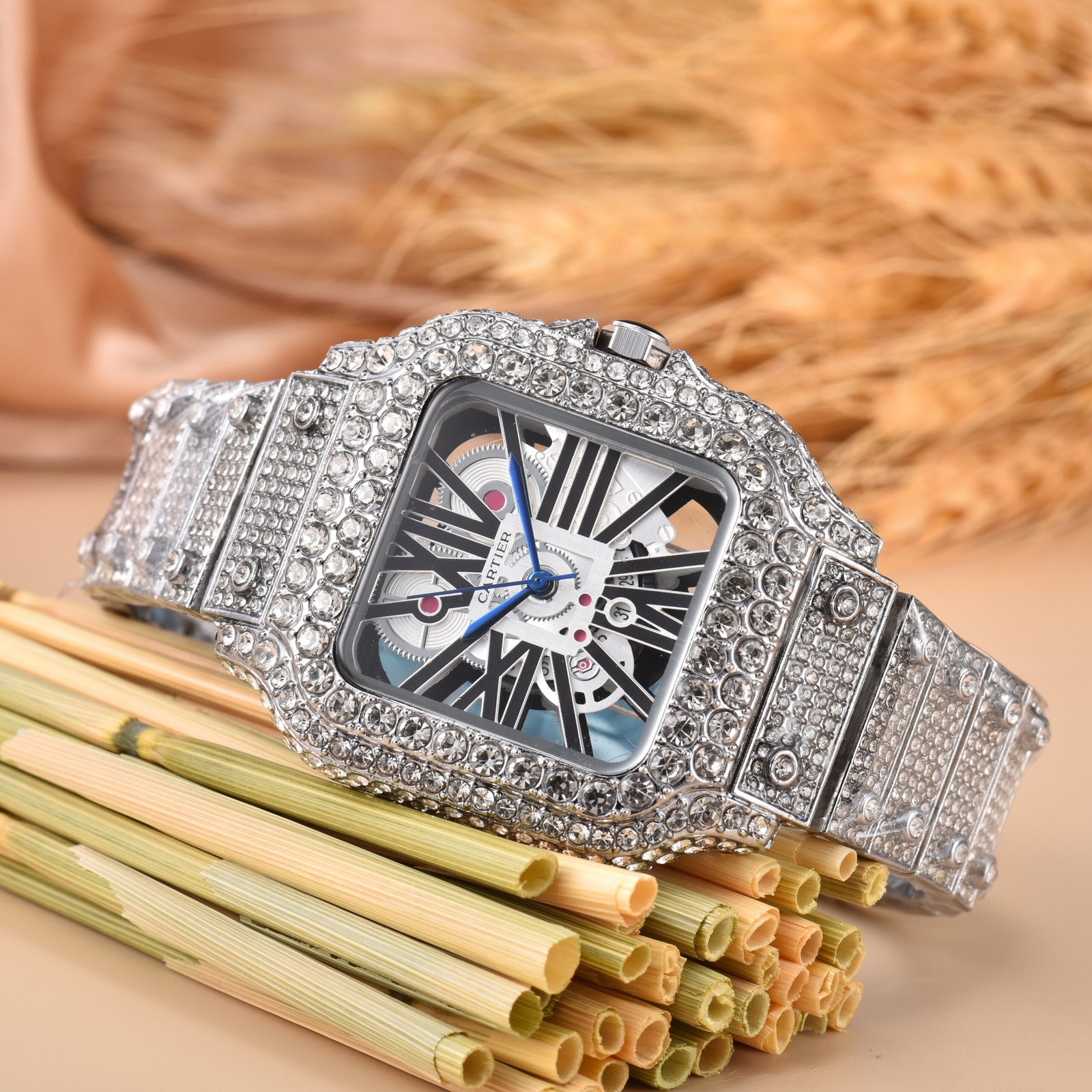
This is where an automatic watch shines. Hundreds of tiny parts work together without electricity, powered only by your movement. Display casebacks and skeleton dials show the balance wheel beating and the rotor spinning, which is fascinating to watch.
Quartz watches are brilliant engineering in their own way, but they rarely create the same emotional connection. For a gift that marks a special moment, many people choose mechanical. See our watch gift ideas for inspiration.
Difference 9: Sensitivity to Magnetism and Shock
Mechanical movements can be affected by strong magnets from speakers, laptops, phone cases and bag clasps. Magnetism makes the hairspring coils stick together, which causes the watch to run very fast. A watchmaker can demagnetise it in minutes. Many modern automatics now use anti-magnetic silicon hairsprings.
Quartz watches are less sensitive to everyday magnetic fields and handle drops well, which makes them excellent sports and travel watches.
Other Movement Types Worth Knowing
The automatic vs quartz debate is not the full picture. Several other movements combine the best of both worlds:
- Manual-wind mechanical: wound by hand daily, often thinner than an automatic watch.
- Solar quartz: recharged by light, so you rarely change the battery.
- Kinetic or automatic quartz: a rotor generates electricity that charges a capacitor.
- Spring Drive: a Japanese hybrid with a mainspring and quartz regulation, known for a perfectly gliding seconds hand.
- Smartwatch: digital and connected, but needs charging every day or two.
A Short History: The Quartz Crisis and the Mechanical Revival
To understand why both movements exist side by side today, it helps to look back at the 1970s and 1980s. When quartz technology arrived, it was dramatically more accurate and, within a few years, far cheaper to produce than traditional mechanical calibres. Japanese and American manufacturers embraced it quickly.
The traditional Swiss industry was slow to respond. Between the early 1970s and the mid-1980s, Swiss watch employment fell sharply and many historic workshops closed. Historians call this period the “quartz crisis.” For a time, it looked as though mechanical watchmaking might become a museum craft.
Then something surprising happened. Collectors and ordinary buyers began to value mechanical watches precisely because they were not the most practical option. They saw them as art, tradition and engineering rolled into one. By the 1990s and 2000s, the mechanical watch had returned as a luxury object, and today it dominates the high-end market.
Quartz never went away. It remains the most popular movement in the world by volume, powering everything from everyday fashion pieces to high-precision luxury models. The two technologies now coexist, each serving a different kind of buyer.
What Do “Jewels” Mean in a Watch Movement?
Product pages often mention “21 jewels” or “25 jewels.” These are not precious gems added for decoration. They are tiny synthetic rubies placed at the points where gears and pivots rub against each other. Because ruby is extremely hard and smooth, it reduces friction and wear.
A simple time-only mechanical movement typically has 17 to 21 jewels. Movements with a date, chronograph or other complications may have 25 or more. More jewels do not automatically mean a better watch, but a fully jewelled movement is a sign of proper construction. Quartz movements usually contain very few jewels, often none at all, because their stepper motor creates far less friction.
Cost of Ownership Over Ten Years
The purchase price is only part of the story. Here is a rough illustration of what each movement may cost to keep running over a decade of regular wear.
| Cost item (10 years) | Self-winding mechanical | Battery quartz |
|---|---|---|
| Routine care | 2–3 full services | 3–5 battery changes |
| Seal and gasket checks | Included in each service | Recommended with each battery |
| Typical relative cost | Higher | Lower |
| Effort required | Wear regularly or wind | Almost none |
Actual prices vary widely by brand, region and watchmaker. Independent watchmakers are often more affordable than brand service centres, but always choose someone experienced with your type of movement.
Is a Mechanical Watch a Good Investment?
Most watches, whether mechanical or quartz, are best seen as objects to enjoy rather than financial investments. Only a small number of famous references hold or increase their value over time. Buy a watch because you love it and will wear it, not because you expect it to make money.
What a mechanical piece does offer is longevity. With care, it can be repaired and passed on, which gives it a kind of value that goes beyond its price tag.
Which One Should You Choose?
The right choice depends on how you live and what you value. Use this simple guide:
Choose an automatic watch if you:
- Love craftsmanship, tradition and the idea of a machine on your wrist.
- Wear the watch most days so it stays wound.
- Want a watch that can be serviced and passed down.
- Enjoy the smooth sweep of the seconds hand.
Choose a quartz watch if you:
- Want maximum accuracy with minimal effort.
- Rotate several watches and want them ready instantly.
- Prefer a lighter, slimmer case.
- Want a lower purchase and maintenance cost.
Many collectors own both: an automatic watch for daily pleasure and a quartz piece for sport, travel or grab-and-go convenience.
How to Wind and Set an Automatic Watch
If you are new to mechanical watches, follow these simple steps:
- If the watch has stopped, unscrew the crown (if it is screw-down) to the first position.
- Turn the crown clockwise 30–40 times to fill the mainspring.
- Pull the crown out to the time-setting position.
- Move the hands forward past midnight to find the correct AM/PM date change.
- Set the time and push the crown back in, screwing it down if required.
- Wear the watch daily so the rotor keeps it wound.
Avoid changing the date between 9 PM and 3 AM on many movements, because the date mechanism is engaged during those hours.
Quick Tips for Daily Life With Each Movement
A few habits make ownership easier. With a mechanical piece, wear it at least a few hours every day or give the crown a short wind each morning. Keep it away from speakers and magnetic bag clasps, and set the date outside the late-evening danger window.
With quartz, the main habit is simply replacing the battery promptly when the seconds hand starts jumping in four-second steps, a common end-of-life warning. A dead battery left inside a watch can leak and damage the movement, so do not ignore it for months.
Common Myths About Automatic and Quartz Watches
- “Quartz watches are cheap.” Not always. Some luxury brands use high-precision quartz movements in serious watches.
- “An automatic watch never needs a battery, so it never needs care.” It needs regular servicing instead.
- “You can over-wind an automatic watch.” Modern automatics have a slipping clutch that prevents over-winding.
- “Quartz watches cannot be serviced.” Good quartz watches can be cleaned, resealed and repaired.
Frequently Asked Questions
Is an automatic watch better than quartz?
Neither is objectively better. An automatic watch offers craftsmanship, a sweeping seconds hand and no battery, while quartz offers higher accuracy and lower maintenance. Choose based on your priorities.
How long does an automatic watch run without being worn?
Most automatic watches have a power reserve of 38 to 80 hours. After that they stop and need a few turns of the crown to restart.
Do automatic watches need batteries?
No. An automatic watch is powered by a mainspring wound by the motion of your wrist. It never needs a battery.
How accurate is an automatic watch?
A typical automatic watch is accurate to within about -10 to +15 seconds per day. Certified chronometers stay within -4 to +6 seconds per day.
How can I tell if my watch is automatic or quartz?
Watch the seconds hand. A smooth sweep usually means an automatic or mechanical movement, while a single tick each second usually means quartz. Words such as “Automatic” on the dial also help.
Is it bad to let an automatic watch stop?
No. Letting an automatic watch stop does not damage it. Simply wind it a few turns and reset the time before wearing it again.
Final Verdict
The automatic vs quartz decision comes down to heart versus head. If you want a living, breathing machine that connects you to centuries of watchmaking, choose an automatic watch. If you want precise, low-maintenance timekeeping that is always ready, choose quartz.
Whichever you prefer, the most important thing is that you love wearing it. Explore our men’s watches, women’s watches and the wider luxury watches collection to find the movement and style that suits you. New to buying? Start with our complete luxury watch buying guide.